Why Reno's Spring Snowmelt Is So Hard on Retaining Walls
If you live in Reno, you already know the pattern: a winter of snow, then a fast warm-up in March and April that turns every roof, driveway, and hillside into a river. That meltwater has to go somewhere, and all too often it goes straight into the soil behind your retaining wall. A wall that looked perfectly solid in January can start leaning, cracking, or bulging by May, and the cause is almost never the block or the concrete itself. It is water.
Reno sits in a high desert valley with steep lots, clay-heavy soils in many neighborhoods, and rapid freeze-thaw cycles. All three combine to make retaining wall drainage the single most important factor in whether your wall lasts 5 years or 50. When meltwater saturates the backfill and cannot escape, it creates what engineers call hydrostatic pressure: the weight of trapped water pushing outward against the back of the wall. That pressure can be thousands of pounds, and no residential wall is designed to fight it indefinitely.
How Hydrostatic Pressure Quietly Destroys a Wall
Hydrostatic pressure retaining wall failures rarely happen overnight. Water seeps into the soil behind the wall, fills the voids, and slowly compacts the backfill into a dense, heavy mass. As more meltwater arrives, the water table behind the wall rises and pushes outward with increasing force. You may first notice small hairline cracks in the mortar or a slight tilt at the top. Over a season or two, that tilt becomes a lean, the lean becomes a bulge, and eventually the wall can shear or topple entirely, sometimes after a single heavy rainstorm following a fast thaw.
Freeze-thaw makes it worse. In Reno, water that seeps in during the day can freeze at night, expand, and pry open joints and micro-cracks. When it thaws, more water gets in. This cycle repeats dozens of times each spring and gradually weakens even well-built Concrete Retaining Walls. The fix is not thicker block or stronger mortar. The fix is giving that water a controlled path out from behind the wall before it can build pressure.
The Role of a Retaining Wall French Drain
A retaining wall french drain is the standard, proven solution for managing water behind a wall. It typically consists of a perforated pipe wrapped in filter fabric and set in a trench of washed gravel at the base of the wall, on the uphill side. Water enters the gravel, flows into the pipe, and is carried away to a safe discharge point, such as a daylight outlet, a storm drain, or a dry well, depending on your lot. Gravel backfill and a filter fabric barrier keep soil from clogging the system, and weep holes through the wall face provide a backup escape route for any water that still reaches the wall.
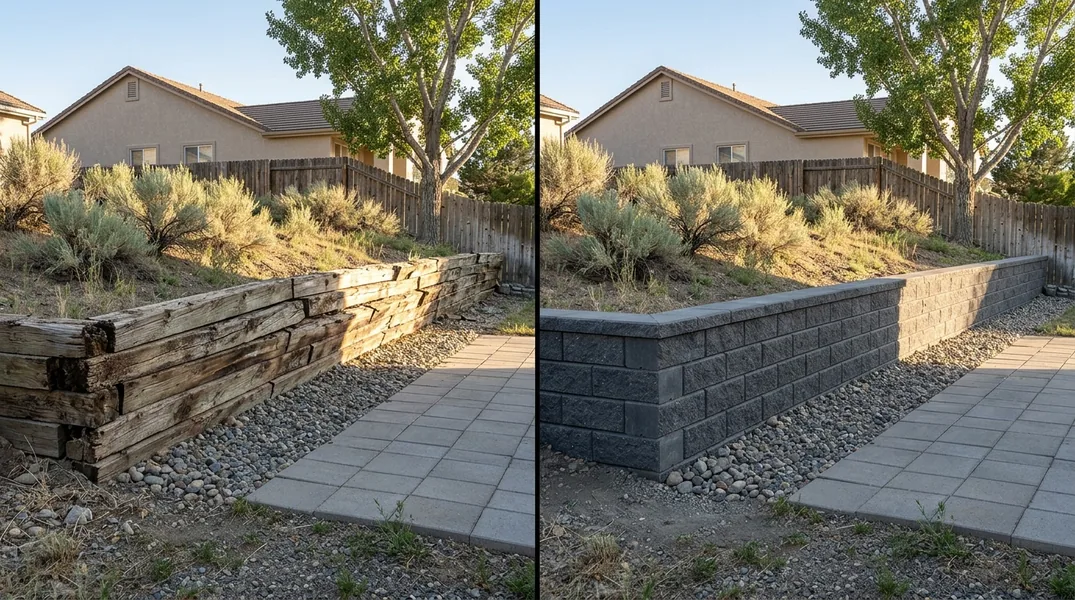
When a french drain is designed correctly for your slope, soil type, and snow load, hydrostatic pressure never gets the chance to build. Water moves down and out instead of pushing sideways. That is the difference between a wall that survives Reno's spring melt and one that needs Retaining Wall Repair within a few seasons. If your wall was built without a drain, or the drain has clogged with silt, adding or restoring proper drainage is often the highest-value improvement you can make.
Warning Signs Your Wall's Drainage Is Already Failing
Most drainage failures give you warning signs before the wall collapses. Look for water pooling at the base of the wall after storms, soil washing out from between blocks, white mineral staining on the face, or weep holes that stay dry during heavy melt (which usually means the drain behind them is blocked). A wall that leans away from the hillside, shows a horizontal crack, or has a bulge in the middle is already under significant hydrostatic pressure and should be evaluated promptly. In Sparks and Spanish Springs, the same signs appear, often on walls facing south where snow melts fastest.
Small problems are cheap to fix. A clogged drain can often be cleared or rebuilt without touching the wall itself. A wall that has already moved significantly may need Retaining Wall Replacement, ideally with a properly engineered drainage system designed for your specific slope and soil. Waiting through another melt season usually makes the repair larger and more expensive.
Retaining Wall Installation Near Me: Getting Drainage Right From Day One
If you are planning a new wall, the most important decision you will make is not the block color or the cap style. It is whether the wall is designed and built with drainage as a core part of the structure. Proper Retaining Wall Installation in the Reno area includes a compacted, free-draining gravel base, a correctly sized and sloped french drain, filter fabric to prevent clogging, and weep holes placed where water actually collects. On taller walls or steep lots, an engineered design may also be required to account for surcharge loads and soil conditions.
Homeowners often ask us for pricing on a new wall and are surprised that drainage can account for a meaningful share of the total. It is worth every dollar. A wall built without drainage is a wall with a countdown timer, especially in a climate with fast spring snowmelt. If you want a wall that will still be standing straight after a decade of Reno winters, start with drainage and build the wall around it. Call Reno Retaining Wall at (775) 993-2344 or request a free estimate to have your wall and its drainage evaluated before the next melt season.
Looking for a professional retaining wall contractor in Reno? Reno Retaining Wall responds fast for all your retaining wall needs.
Get a Free QuoteOur services: Retaining Wall Installation · Retaining Wall Repair · Retaining Wall Replacement