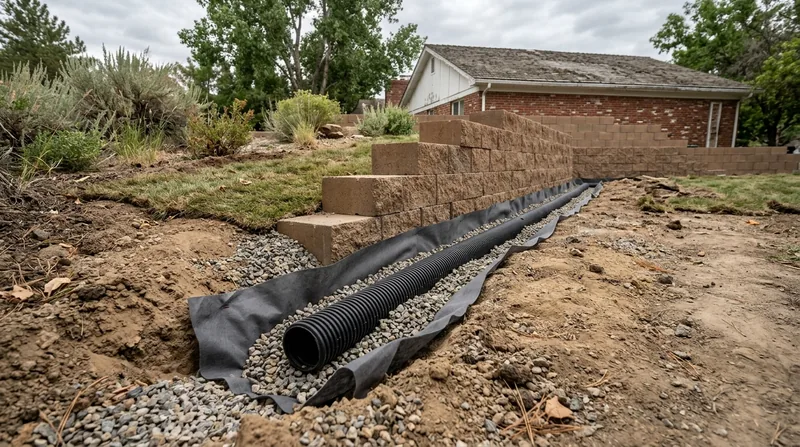




Retaining Wall Drainage in Reno: Keep Water From Tearing Your Wall Apart
If you own a retaining wall in Reno, the biggest threat to it is not the weight of the soil behind it. It is the water that gets into that soil and cannot get out. Retaining Wall Drainage in Reno is the work of moving snowmelt, rain, and groundwater away from the wall before it builds pressure and pushes the wall forward. Reno sits at about 4,500 feet in the Truckee Meadows, ringed by steep sagebrush foothills and volcanic ridges, and our soils are a mix of decomposed granite, volcanic material, and pockets of expansive clay that do not drain well on their own. Add real freeze-thaw winters and spring snowmelt, and a wall that looked fine in July can start to lean by March. We design and install drainage systems that relieve that pressure, and we repair the walls that already show the damage. If your wall is already moving, start with leaning and collapsed wall repair before the problem gets worse.
Why Drainage Decides Whether a Reno Wall Lasts
Reno walls fail from the inside out. Water saturates the backfill, adds enormous weight, and freezes in winter, expanding and cracking the wall face. In the foothills around Caughlin Ranch, Somersett, and ArrowCreek, lots are cut into slopes, so water from uphill keeps arriving at the wall. In the Old Southwest and Newlands, old river-rock walls sit on soils that have been wet for a century. The failure mode we see most is a wall that bulges or leans after a wet spring, which is exactly what poor drainage produces.
- Hydrostatic pressure builds when saturated backfill cannot drain and pushes the wall outward.
- Frost pressure cracks block faces and lifts footings during Reno's freeze-thaw cycles.
- Expansive clay swells when wet and shrinks when dry, shifting the wall season after season.
- Washouts and erosion undercut footings where water pours over the top or around the ends.
- Clogged or missing weep holes trap water behind the wall with no way out.
Every one of those problems is cheaper to prevent with proper drainage than to fix after the wall moves.
Key info: In the North Valleys around Cold Springs and Lemmon Valley, we routinely find timber and railroad tie walls from the 1970s and 1980s with no gravel backfill and no drain at all. They hold until a heavy snowmelt year, then fail all at once.
For official guidance on when a wall needs a permit and an engineered design, check the City of Reno building department and the Nevada State Contractors Board before you build or rebuild: City of Reno.
How We Build Drainage That Works in Reno Soils
We do not guess at drainage. We open the wall, look at the soil, the slope, and where the water is actually coming from, then build a system sized for that site. A wall on a flat lot in Sparks needs a different setup than a terraced wall stepping up a hillside in Galena Forest. The goal is always the same: collect water behind the wall, filter out the fines, and get it out and away from the footing.
- We excavate behind the wall and remove saturated or clay-heavy backfill that will not drain.
- We line the trench with filter fabric so soil does not clog the drain stone.
- We install a perforated French drain pipe at the base, pitched to a daylight outlet.
- We backfill with clean washed gravel, not the native decomposed granite.
- We core or restore weep holes through the wall face at the low points.
- We cap the wall and grade the surface so runoff flows away, not into the backfill.
- We tie the outlet into a safe discharge point, a dry well, or a storm path that will not erode a neighbor's slope.
When the wall itself is already damaged, we combine drainage with structural repair so the fix actually holds. You can see how that works on our retaining wall repair page.
Local example: A hillside wall in Verdi was leaning six inches after spring snowmelt. We pulled the saturated clay backfill, installed a French drain with a gravel envelope and filter fabric, restored the weep holes, and reset the top courses. Two winters later the wall has not moved.
Drainage Approaches We Use on Reno Walls
Not every wall gets the same system. The right approach depends on wall height, soil, slope above the wall, and how much water the site receives. Here is how we match the method to the site.
| Approach | Description | Best for |
|---|---|---|
| French drain behind the wall | Perforated pipe in washed gravel wrapped in filter fabric, pitched to an outlet. | Most walls over 3 feet, especially on slopes. |
| Weep holes and face drainage | Cored outlets through the wall at low points to release trapped water. | Concrete and block walls with no existing outlets. |
| Gravel backfill and filter fabric | Clean drain stone replaces native soil, fabric keeps fines out. | Walls built in decomposed granite or clay soils. |
| Surface grading and swales | Regrade the ground above the wall to divert runoff before it reaches the backfill. | Hillside lots in Somersett, ArrowCreek, and Caughlin Ranch. |
| Chimney drain on tall walls | Vertical gravel columns that carry water down to the base drain. | Tall or tiered walls holding large uphill areas. |
We pick the combination that fits your wall, and we tell you plainly when a repair is not worth it and a replacement is the better spend.
Retaining Wall Drainage Cost in Reno: What to Expect
Drainage work starts at From $2,500 for a typical residential wall. That figure covers opening the wall, removing bad backfill, installing a French drain with gravel and fabric, and restoring weep holes on a standard-height wall. The price climbs with wall length and height, how much saturated soil has to come out, steep access in the foothills, and whether the wall also needs structural repair. A short wall on a flat Sparks lot sits near the bottom of the range; a tall terraced wall in Galena Forest with limited machine access sits well above it.
Get two or three written estimates and compare scope, not just the number. A low bid that skips the gravel envelope or the outlet is not a deal, it is a callback waiting to happen. Our pricing page breaks down the ranges in more detail.
Hiring a Retaining Wall Drainage Contractor Near Me in Reno
Drainage is invisible once the gravel goes back in, so hire someone who will show you what they did. Ask for proof of insurance, get the scope in writing, and call past customers whose walls have been through at least one snowmelt. Confirm who pulls the permit if your wall is above the local height threshold or supports a driveway or structure, because thresholds vary by jurisdiction and the building department has the final say. We are fully insured, and we will walk you through the plan before we dig.
If your wall is in a historic neighborhood or an HOA, check the rules before work starts. Then call us at (775) 993-2344 or use our contact page to set up a free estimate. For walls that are already failing, do not wait for the next wet spring: retaining wall replacement is sometimes the honest answer, and we will tell you when it is.
Retaining Wall Drainage in Reno: Pricing Guide
| Service | Price | Details |
|---|---|---|
| Basic French drain behind existing wall | Starting at $2,500 | Includes excavation, perforated pipe, washed gravel, filter fabric, and weep hole restoration on a standard wall. |
| Full drainage retrofit with backfill replacement | Starting at $4,200 | Removes saturated clay or decomposed granite backfill, rebuilds the drain envelope, and regrades the surface above. |
| Tall or tiered wall chimney drain system | Starting at $6,500 | Adds vertical gravel columns and multiple outlets for walls holding large uphill drainage areas. |
| Drainage combined with structural wall repair | On estimate | Needs an on-site look to assess wall movement, footing condition, and how much of the wall must be rebuilt. |
| Travel | Included | In Reno and surrounding areas, no separate call-out or mileage fee. |
| Estimate | Free | Response within 24h at (775) 993-2344, no obligation to book. |
Indicative pricing, the exact cost depends on square footage, finish, and site access. Free personalized estimate within 24h at (775) 993-2344.


