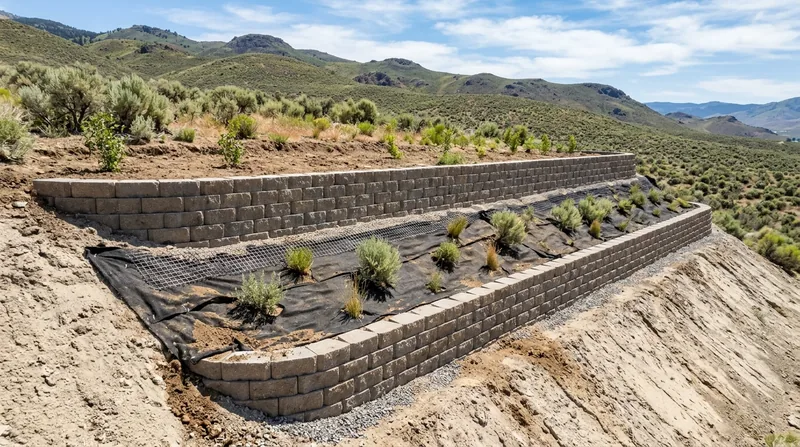




Slope Stabilization & Erosion Control in Reno: Holding the Hillside Where It Belongs
Reno sits at about 4,500 feet in the Truckee Meadows, ringed by steep sagebrush foothills and volcanic ridges. Newer subdivisions climb those slopes in Caughlin Ranch, Somersett, ArrowCreek and Galena Forest, and every one of those lots sheds water downhill. When decomposed granite and volcanic soils ravel after a hard rain or spring snowmelt, Slope Stabilization & Erosion Control in Reno becomes the difference between a landscaped yard and a mud channel headed for your foundation. We build terraced walls, set geogrid reinforcement and cut proper drainage so the slope stops moving. Homeowners in the Old Southwest, Newlands and the North Valleys call us when the ground above the house starts to creep. If your wall is already leaning, start with our leaning and collapsed wall repair page, then we stabilize what is behind it.
Why Reno Slopes Fail: Dry Soils, Freeze-Thaw and Spring Melt
Reno's climate is hard on hillsides. We get real freeze-thaw winters, a fast spring snowmelt off the Sierra, and long dry stretches that leave decomposed granite loose and powdery. Add pockets of expansive clay and the shaking risk that comes with living near active faults, and a bare slope has plenty of reasons to move. The failure mode that dominates here is surface raveling and shallow sloughing after intense rain or rapid melt, not coastal-style saturation.
- Bare cuts behind homes in Somersett and ArrowCreek lose topsoil with every storm and expose the footing of the wall below.
- Wildfire defensible-space clearing in Galena Forest and Washoe Valley removes vegetation that was holding the surface together.
- Roof downspouts and driveway runoff dump concentrated water onto slopes that were never graded for it.
- Old timber and railroad tie walls rot out and stop retaining anything, letting the hillside above slide into the yard.
- Truckee River banks in the Wells Avenue district and along the river corridor scour during high water, as they did in the 1997 New Year's flood.
Each of these problems has a fix, but the fix has to match the soil and the slope angle, not a generic recipe.
Key info: A homeowner in Caughlin Ranch had a bare decomposed granite cut above the driveway that washed a foot of material into the street every spring. We terraced it with two segmental block walls, added geogrid and a surface drain, and the driveway has stayed clear through three melt seasons.
Before any work starts, it pays to understand what your jurisdiction requires. Wall height thresholds and engineered drawing rules vary, so confirm with the local building department, and you can review Nevada contractor resources through the Nevada State Contractors Board.
How We Stabilize a Reno Hillside, Step by Step
We start by reading the slope, not by selling you a wall. We look at soil type, drainage paths, the angle of the cut, and what sits above and below it. Then we design a system that moves water away and holds the soil in place. Every job follows the same sequence, adjusted for the site.
- We walk the slope with you and mark where water enters, ponds and exits.
- We probe the soil to identify decomposed granite, volcanic material or expansive clay and adjust the design.
- We excavate and bench the slope to create stable terraces instead of one tall face.
- We install drainage, including footing drains, surface swales and outlet pipes that carry water to a safe release point.
- We place geogrid reinforcement in lifts behind segmental block or boulder walls to tie the structure into the hillside.
- We seed, mulch or armorkey the exposed surface so rain hits vegetation instead of bare dirt.
On steeper lots we often combine a boulder toe wall with planted terraces above, which suits the basalt and granite look of the foothills.
Key info: In Spanish Springs, a homeowner cleared sagebrush for defensible space and the next monsoon season carved a gully toward the patio. We rebuilt the slope with a boulder toe, geogrid-backed terraces above it and a rock-lined swale, and the gully has not returned. See our boulder and natural stone walls for the material side of that work.
Stabilization Methods We Use on Reno Slopes
The right method depends on slope angle, soil, water volume and what you are protecting. Here is how the main approaches compare.
| Approach | Description | Best for |
|---|---|---|
| Terraced segmental block walls | Stacked block walls with geogrid layers tie the face back into the hillside. | Stepped lots in Somersett, Damonte Ranch and Double Diamond |
| Boulder toe and rock walls | Heavy natural stone at the base resists scour and anchors the slope. | Foothill properties with granite and basalt on site |
| Surface drainage and swales | Graded channels and drains divert runoff before it saturates the soil. | Any slope below a driveway, roof or cleared defensible space |
| Erosion blanket and revegetation | Seed, mulch and erosion control fabric protect bare soil until plants establish. | Recently cleared or graded slopes that need surface protection |
| Riverbank armoring | Rock and structural protection along eroding banks and high-water channels. | Truckee River corridor properties in Reno and Sparks |
Most real jobs combine two or three of these, because water and soil rarely behave the way a single method expects.
Slope Stabilization & Erosion Control Cost in Reno: What to Expect
Every job starts with a free estimate, and that is the only honest starting point because slope work is site-specific. A small surface erosion fix on a Verdi lot is a different project from a full terraced system above a home in ArrowCreek. We price by the linear foot of wall, the volume of soil moved, drainage runs and the reinforcement required.
Factors that move the number most: slope height and angle, soil type (decomposed granite is easier to work than expansive clay), access for equipment, how close the work sits to the house or driveway, and whether engineered drawings are required. Getting two or three estimates is smart, and it helps to compare scope line by line rather than just the bottom number. Our pricing overview lays out the ranges so you can read each bid with context.
Cheap usually means no drainage and no geogrid, which is exactly how a slope fails a second time.
What to Look for When Hiring a Retaining Wall Contractor Near Reno
Slope work is structural work, so treat the hiring process the same way you would for a foundation repair. Ask questions, check the paperwork and compare written scopes. A contractor who cannot explain the drainage plan is not ready for a hillside.
- Confirm the contractor carries insurance and ask for a certificate before work begins.
- Get multiple written estimates that describe excavation, drainage, reinforcement and revegetation separately.
- Ask for references from jobs on similar slopes, ideally in your part of Reno or Sparks, and call them.
- Ask who handles permits and whether the local building department requires engineered drawings for your wall height.
- Check HOA rules in subdivisions like Somersett or Damonte Ranch before you change wall materials or height.
If a bid sounds too good, ask what it leaves out. Then reach us through our contact page to compare a scoped, no-pressure estimate.
For homeowners in the 89501 ZIP and nearby, our Reno 89501 service page covers how we handle the older neighborhoods near the river and downtown.
Slope Stabilization & Erosion Control in Reno: Pricing Guide
| Service | Price | Details |
|---|---|---|
| Surface erosion control and revegetation | Free estimate | Covers grading, seed, mulch and erosion blanket on a bare slope, priced by square footage and access. |
| Drainage correction and swale work | Starting at $1,800 | Includes footing drains, surface swales and outlets, with run length and trench depth driving the final number. |
| Terraced retaining wall stabilization | Starting at $4,500 | Includes excavation, segmental block or boulder terraces and geogrid, priced by wall height and linear feet. |
| Full hillside stabilization system | On estimate | Combines walls, drainage and reinforcement, so slope angle, soil type and proximity to the house need an on-site look. |
| Travel | Included | In Reno and surrounding areas, no separate call-out or mileage fee. |
| Estimate | Free | Response within 24h at (775) 993-2344, no obligation to book. |
Indicative pricing, the exact cost depends on square footage, finish, and site access. Free personalized estimate within 24h at (775) 993-2344.


